
Latin name: Pterois
Location: Native to Indo-Pacific, invasive in Atlantic, Caribbean and Gulf of Mexico
Size: 20–30 cm
Fun fact: Lionfish can expand their stomachs up to 30 times their normal size to swallow prey whole.
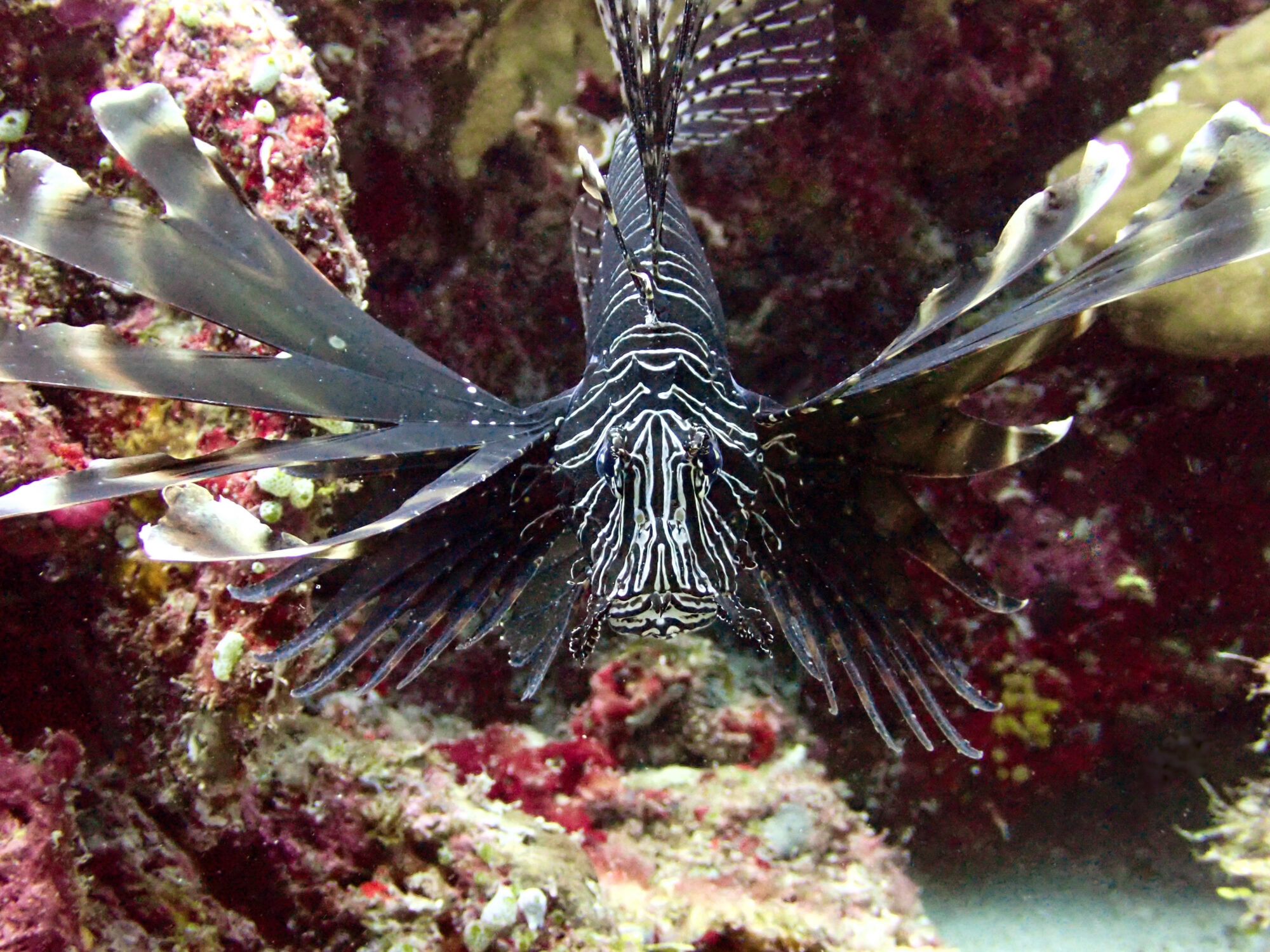
Lionfish are beautiful fish to see on the reef, although you shouldn’t get too close as they have venomous spines. There are several species of lionfish, and all should be treated with care. They are also one of the easiest fish to spot on the reef because they look so different from most of the other fish around them.
Appearance
Lionfish are related to scorpionfish and, like their relatives, they have venomous spines. They have long spines along their dorsal fin, as well as spines around their pelvic and anal fins.
When they feel threatened, they will spread their fins and spines, making themselves look much larger. From the front, this can look a little like a lion’s mane, which is where they get their name.
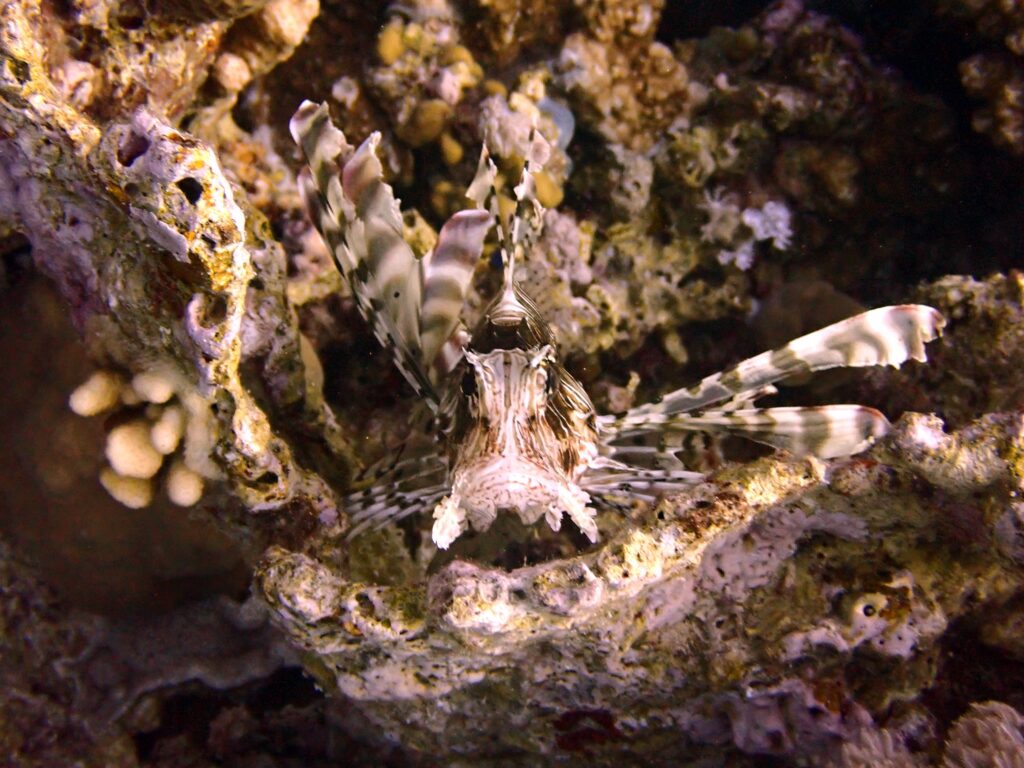
You can often spot lionfish slowly moving along the reef while hunting for prey. During this time, they tend to keep their fins closer to their body. When resting, they like to stay close to rocks and underneath ledges. I have even seen many of them happily chilling out whilst swimming upside down!
They can grow to around 30 cm in length, so they are relatively easy to spot, even when they are trying to hide.
Lionfish have vertical stripes running along their bodies. These are usually shades of brown, red, white and sometimes darker colours, although their exact patterns and colours vary between species. Their striking colours can act as a warning to predators, whilst their patterns can also help them blend into the reef when hunting.
Some species also have small, fleshy tassels around the mouth and chin, almost making them look as though they have a little beard.
One of my favourite features of lionfish is the pair of small, feeler-like structures around their head, known as tentacles. Their size and shape can vary between species, and they are thought to play a role in courtship and mating behaviour. Some species have much longer and more noticeable tentacles than others, which makes them a great feature to look out for when trying to identify different lionfish.
Hunting
Watching a lionfish hunt is amazing to witness. They usually try to sneak up on their prey very slowly, using their large fins to help herd and corner smaller fish.
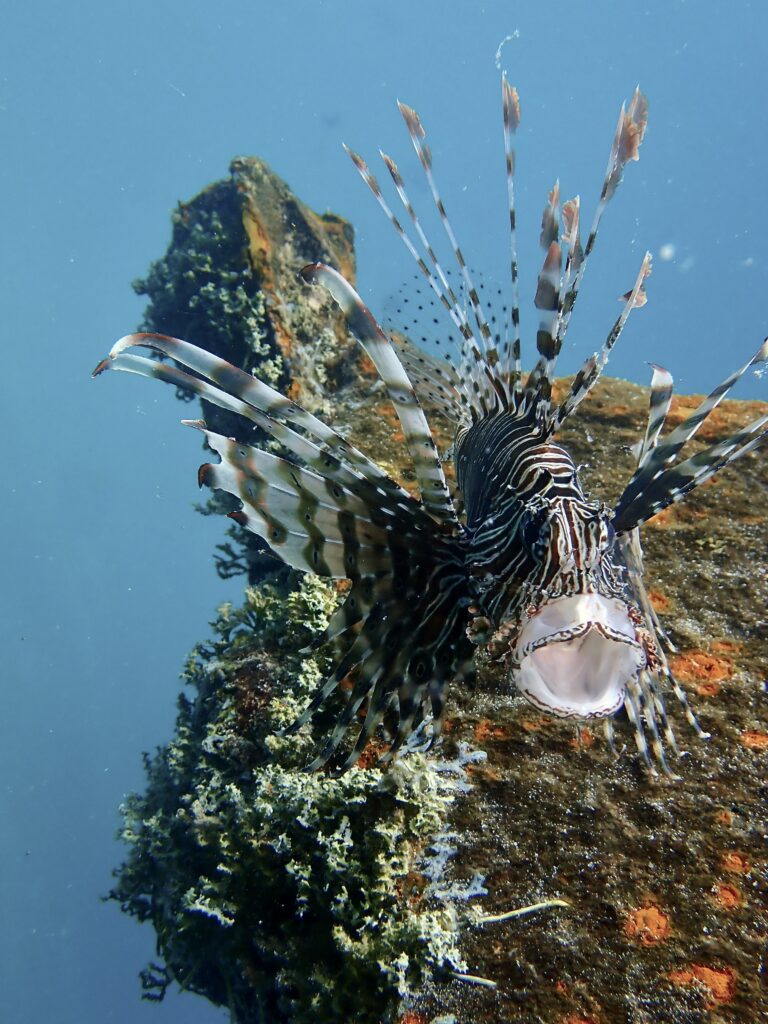
Once they get within striking distance, everything changes. They can move with tremendous speed, opening their huge mouths and gulping down their prey in the blink of an eye.
They can open their mouths incredibly wide, allowing them to swallow surprisingly large prey. The whole attack can happen in less than a second.
Lionfish can hunt during both the day and night. If you’re lucky enough to see one hunting on a night dive, you might notice something particularly interesting: they can take advantage of the light from a diver’s torch. When your torch illuminates a small fish, the lionfish may use the opportunity to move in and catch it.
If you ever get the chance to watch one hunting, have your camera ready. Watching the footage back in slow motion can be amazing and gives you a much better idea of just how fast their strike really is and how big their mouth can be.
An Expandable Stomach
Lionfish have an incredible ability to expand their stomachs, allowing them to swallow surprisingly large meals. Their stomach contains folds of stretchy tissue that can unfold and expand as food enters, whilst their flexible abdominal wall allows extra room for the meal.
This works perfectly with the way they hunt. When a lionfish strikes, it opens its mouth extremely wide and creates a powerful suction that helps pull its prey straight into its mouth. The prey is usually swallowed whole.
Their expandable stomach means they can eat a surprisingly large amount in a single meal. Once the food has been digested, the stomach can shrink back down again.
Invasive Species
Lionfish are naturally found throughout the Indo-Pacific, where they are part of the local reef ecosystem and have natural predators, including larger groupers. However, lionfish have become a major invasive species in parts of the Atlantic, Caribbean and Gulf of Mexico. They are not native to these areas and are thought to have been introduced through the aquarium trade, including fish that were released or escaped into the wild.
Their populations have grown rapidly in these new environments. With relatively few natural predators and a large appetite, lionfish can consume large numbers of smaller reef fish and other animals, including crustaceans and molluscs.
This can put additional pressure on native reef species and disrupt the balance of local ecosystems. As a result, organised lionfish removal programmes take place in some areas to help control their numbers.
It is important to remember that lionfish themselves are not an invasive species everywhere. In places such as the Indo-Pacific, they are native fish and an important part of the natural reef ecosystem.
Venom & Defence
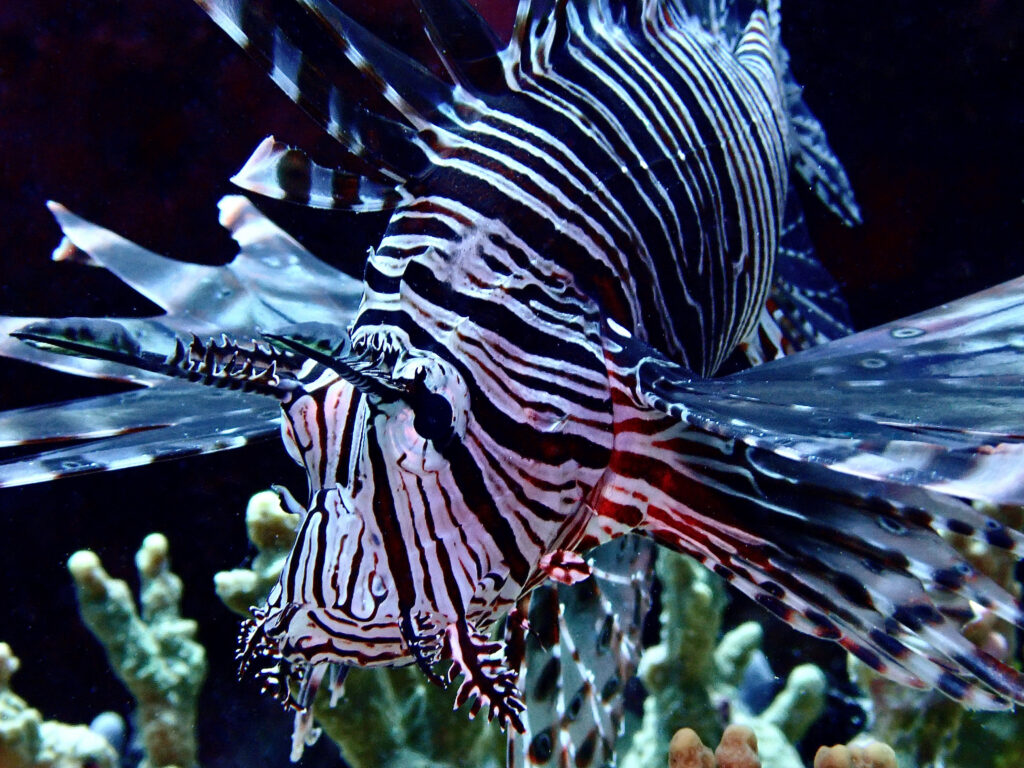
As beautiful as lionfish are, their impressive spines are not just for show. Lionfish are venomous, meaning they can inject venom through their spines when they are touched or pressed.
The venom is made up of a mixture of different proteins and chemicals. When the venom enters the skin, it affects the nerves and causes a strong pain response. It also causes inflammation, which can lead to swelling and redness around the sting.
A lionfish sting can be extremely painful, and the pain can last for several hours or sometimes longer. The area around the sting may become swollen, red and very sensitive. In more serious cases, a person may experience nausea, sweating, dizziness or changes in their heart rate and blood pressure.
Luckily, lionfish are not aggressive towards divers. Their venom is mainly used as a defence against predators rather than to attack. Their large, flowing fins and long spines make them look much larger and more difficult for a predator to swallow. If a predator does try to attack, those spines provide a very effective defence.
This is why, even though lionfish can sometimes allow you to get surprisingly close, they should never be touched. They may look calm and relaxed, but those beautiful spines are there for a reason!